


In 2026, we were obsessed with our rings, watches, and patches. We spent half our day checking “Sleep Scores” and “Body Battery” numbers like they were the stock market. But here’s the thing about 2027: nobody wants to look at a dashboard anymore.
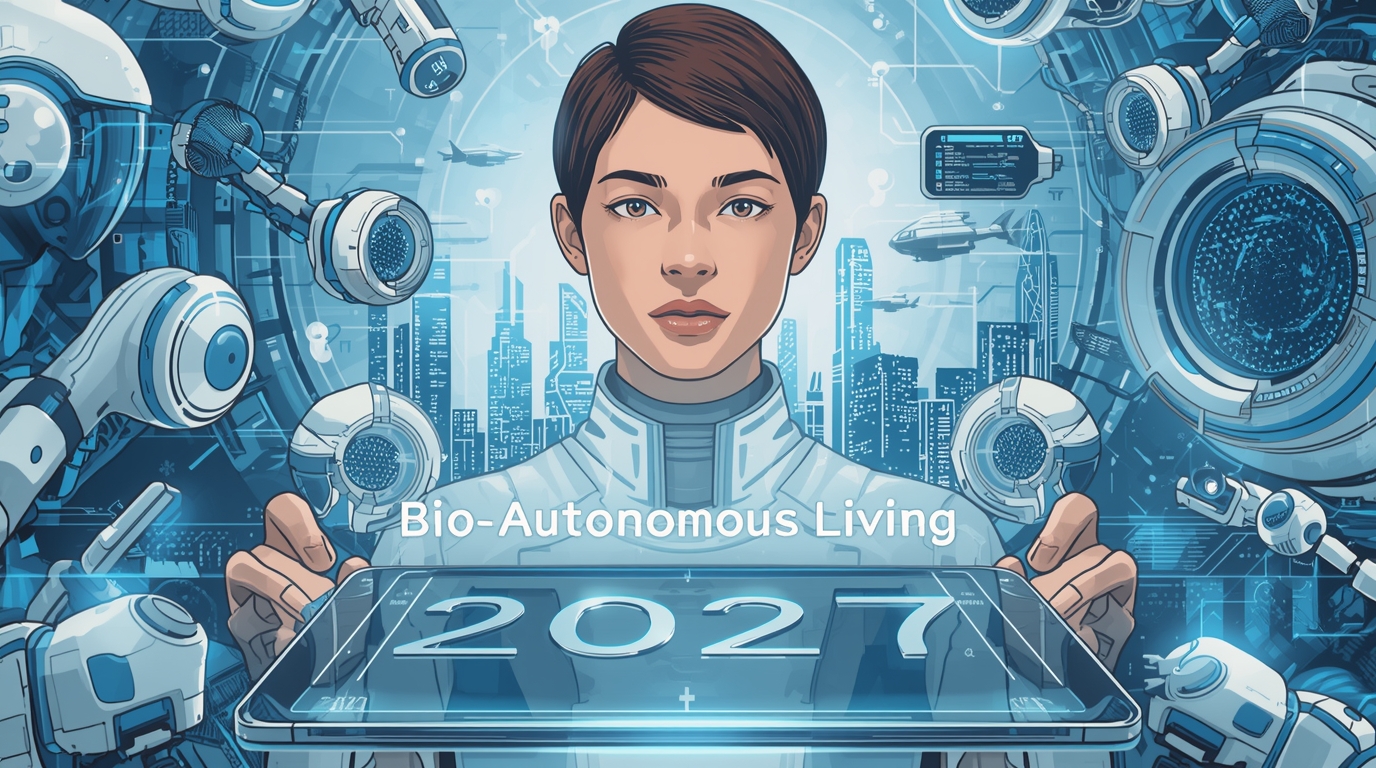
We’ve reached “Tracker Fatigue.” In 2027, the trend has shifted from passive monitoring (where you look at a graph and feel bad about your life) to Bio-Autonomous Living. This is the year your health tech starts making decisions for you, often before you even know there’s a problem.
The End of the “Nudge”: What is Bio-Autonomy?
For the last few years, your watch would “nudge” you. “Time to stand up!” it would chirp, usually while you were in the middle of a delicate surgery or a high-stakes board game. You’d ignore it, of course.
Bio-Autonomous Living is different. It’s a world where your environment and your biology are in a constant, invisible conversation. Instead of a notification telling you that you’re stressed, your “Smart Home” simply dims the lights, shifts the HVAC to a calming temperature, and plays a frequency that lowers your heart rate. You didn’t “do” health; the room did it for you.
The Three Pillars of the Bio-Autonomous Shift
-
Agentic Health AI: AI that doesn’t just show you data but acts as a “Biological Executive Assistant.”
-
Environmental Integration: Your house, car, and office are now essentially large-scale medical devices.
-
Closed-Loop Systems: Tech that detects a deficiency (like low hydration or high cortisol) and triggers a fix without your manual input.
The “Smart Home” is Now a “Biological Cocoon”
In 2027, “Home Automation” isn’t about asking Alexa to play disco music. It’s about Circadian Lighting and Air-Based Nutrients.
The Kitchen That Actually Cares
Your fridge in 2027 isn’t just a cold box; it’s a pharmacy. Linked to your continuous glucose monitor (CGM) and your recent blood work, it literally won’t let you see the high-sugar snacks if your insulin sensitivity is trashed for the day. (Okay, it’ll let you see them, but it’ll put them behind a very judgmental-looking digital fog).
-
The Vibe: “I’m not stopping you from eating that brownie, Dave, but I have highlighted the broccoli in a divine golden glow.”
-
The Reality: Smart ovens now adjust cooking temperatures to preserve the exact phytonutrients your body is currently lacking.
The Bedroom: The Ultimate Recovery Lab
We’ve moved past the “Smart Mattress.” In 2027, we have Autonomous Sleep Environments. Using non-wearable sensors (radar and thermal), the room detects when you enter REM sleep. It then adjusts the oxygen mix in the air and the firmness of the bed in real-time to prevent snoring or waking up.
Wearables: From “Data Dumps” to “Biological Agents”
The wearable of 2027 doesn’t have a screen. Why would it? You don’t need to see your heart rate if the device is already managing it.
| Device Type | 2025 Capability | 2027 Bio-Autonomous Power |
| Smart Ring | Tells you that you slept poorly. | Pre-orders a specific supplement for you. |
| Hearables | Cancels noise. | Uses “Vagus Nerve Stimulation” to stop a panic attack. |
| Smart Patch | Tracks Glucose levels. | Automatically signals your phone to order a low-glycemic meal. |
The Rise of “Neuro-Hygiene”
The biggest signal of 2027 is the Focus Thermostat. These are ear-worn devices that monitor your “Cognitive Load.” If the AI detects that your brain is entering a “Flow State,” it autonomously puts your phone on “Do Not Disturb” and mutes your Slack notifications. It’s basically an AI bodyguard for your brain.
The Humor of the “Bio-Autonomous” Life
Let’s be honest: there’s something a little funny about our tech being smarter than our willpower.
-
The “Judgmental” Coffee Maker: Imagine a world where you walk up to your espresso machine and it says, “No, Steve. Your cortisol is already peaking. You get a decaf chamomile, and you’re going to like it.”
-
The “Social Battery” Alert: In 2027, your glasses might give you a subtle red tint when they detect your social battery is at 5%, giving you a valid biological excuse to leave the party without saying goodbye to everyone.
The “Invisible” Doctor: Remote Patient Monitoring 2.0
By 2027, we’ve moved from “Remote Monitoring” to “Predictive Triage.” Thanks to the massive adoption of AI agents, your doctor doesn’t wait for you to call. Your Bio-Autonomous Agent sends a report saying, “Patient 405 has a 78% chance of developing a respiratory infection in the next 48 hours based on micro-changes in their vocal cords and breathing patterns.”
You get a package in the mail with specific antivirals before you even feel a sniffle. It’s incredibly efficient, though it does take the fun out of calling in sick to work.
Why 2027 is the Turning Point
We are finally moving away from “Health as a Task.” For years, being healthy felt like a second job—track this, weigh that, log this meal.
The Bio-Autonomous Year is about reclaiming that time. By delegating the “thinking” part of health to localized, privacy-first AI, we can go back to just… living. We aren’t looking at the tracker anymore because the tracker has become the engine, not just the speedometer.
Summary: The 2027 Health Manifesto
-
Privacy First: Your biological data stays on the device (Edge AI), not in the cloud.
-
Action over Observation: Don’t tell me I’m stressed; fix the room.
-
Preventative by Default: If the tech is working, you never actually feel “sick.”