


The Death of the “Snapshot” Appointment
For the last hundred years, medicine has been about snapshots. You feel sick, you go to the clinic, they take your vitals, and the doctor makes a guess based on that single moment in time. It’s like trying to understand a 2-hour movie by looking at one blurry Polaroid frame.
In 2026, we’ve moved to the Feature Film model. Thanks to the “Internet of Medical Things” (IoMT), your AI doctor has a continuous stream of data.
-
Continuous Monitoring: Your smartwatch, ring, or even your smart-shirt is sending data 24/7.
-
Contextual Health: The AI knows that your heart rate is high not because you’re having a medical emergency, but because you’re currently watching the season finale of your favorite thriller.
-
The Baseline Factor: Instead of comparing you to a “national average,” the AI compares you to yourself.
Comparison: The Old Clinic vs. The 2026 AI Suite
| Feature | The 1990s-2020s Model | The 2026 AI Model |
| Data Collection | Once every 6 months (if you’re good) | 60 times per minute (always on) |
| Diagnosis | Reactive (Wait for symptoms) | Proactive (Predict the crash) |
| Patient Knowledge | “I think I feel a bit tired?” | “Your REM sleep dropped by 12%.” |
| Waiting Room | 45 minutes of silence and sniffles | 0 minutes (The AI is already in your pocket) |
Agentic AI: The Doctor That Never Sleeps
We’ve moved past simple chatbots that just tell you to “drink more water.” In 2026, we have Agentic AI. This means the AI doesn’t just give you information; it takes action.
If your wearable detects an irregular heart rhythm (AFib) while you’re sleeping, the AI doesn’t just send a push notification that you’ll ignore until morning. It acts as a Medical Air Traffic Controller:
-
Validates the Signal: It cross-references your heart rate with your movement and oxygen levels to make sure it’s not a false alarm.
-
Alerts the Human: It sends a high-priority brief to your human cardiologist.
-
Pre-Orders Diagnostics: By the time you wake up, an appointment for an EKG is already flagged in your calendar, and your insurance has already “pre-approved” the visit via an automated AI-to-AI handshake.
The Funny Part: It’s basically having a very polite, very persistent Italian mother living in your smartphone. “I see you haven’t walked today, Gerald. Do you want to get a blood clot? Because this is how we get blood clots.”
The “Ambient Scribe” and the End of Eye-Contact Deprivation
Remember when doctors spent 90% of your visit staring at a computer screen, typing furiously while you talked to the side of their head? That’s over.
In 2026, Ambient AI Scribing has become the industry standard. There’s a discreet microphone in the room (or on your phone during a telehealth call) that listens to the conversation.
-
Natural Conversation: The doctor actually looks at you. You talk like human beings.
-
Auto-Documentation: The AI filters out the small talk about the weather and automatically populates the medical chart, assigns the correct ICD-10 billing codes, and drafts the prescription.
-
Accuracy: It doesn’t forget that you mentioned a slight “tingle” in your left toe, even if the doctor was distracted by their pager.
Early Warning Systems: Detecting the “Invisible”
The real magic of 2026 isn’t just tracking what’s happening; it’s predicting what’s about to happen. AI models are now trained on millions of hours of physiological data.
The Three Major Breakthroughs of 2026
-
The Sleep Foundation Models: AI can now predict the risk of over 130 conditions—including Parkinson’s and Dementia—just by analyzing your sleep architecture (how you move and breathe during the night) years before you show physical tremors.
-
Vocal Biomarkers: During your check-in, the AI analyzes the “micro-tremors” in your voice. It can detect early-stage depression or even heart failure based on the fluid buildup affecting your vocal cords.
-
The Bathroom Lab: Yes, it’s a bit gross, but smart toilets are finally a thing. They analyze “samples” in real-time, checking for everything from hydration levels to early markers of colon cancer.
“Your toilet now has a higher IQ than your high school chemistry teacher. Just try not to think about it too much while you’re sitting there.”
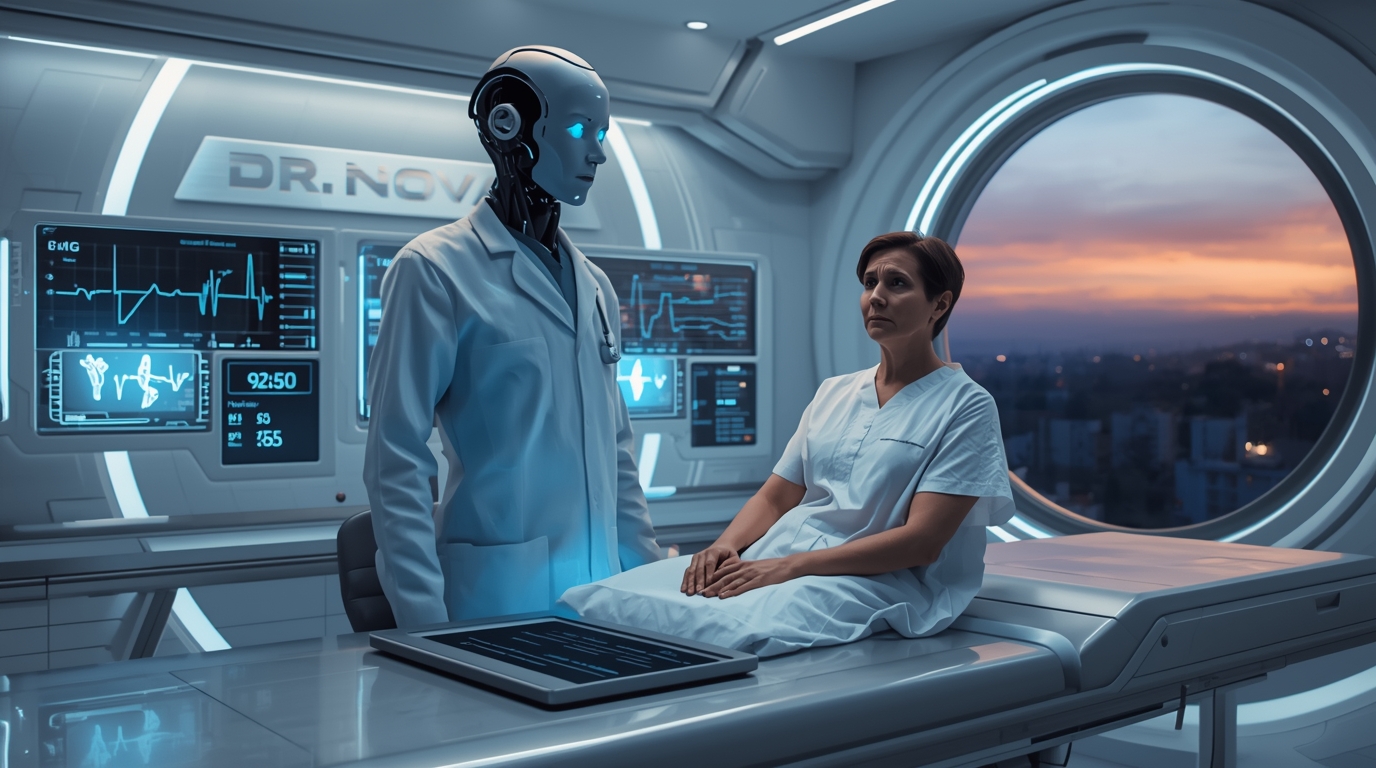
The Human-AI Partnership (The “Co-Pilot” Reality)
Despite the sci-fi vibes, your human doctor isn’t going anywhere. Instead, they’ve been upgraded. We call this the Human-in-the-Loop model.
The AI handles the “boring” stuff—data entry, checking for drug interactions, and monitoring vitals. This leaves the human doctor to handle the things AI is still terrible at: Empathy, Nuance, and Complex Ethics.
The 2026 Medical Workflow
-
The Flag: AI detects a 15% drift in a patient’s respiratory baseline.
-
The Summary: AI provides the doctor with a “One-Page Truth” (The Golden Record) summarizing the last 30 days of the patient’s life.
-
The Intervention: The doctor calls the patient. They don’t spend time asking “How have you been feeling?” because they already know. They spend time asking “Why haven’t you been taking the meds?” or “Let’s talk about the stress at your job.”
The Challenges: It’s Not All Rainbows and Robots
We have to be honest—handing your entire biological blueprint to an algorithm comes with some “yikes” moments.
-
Privacy Paranoia: If the AI knows you’re about to get sick before you do, who else knows? There are massive debates in 2026 about whether life insurance companies should be allowed to see your “Predictive Risk Score.”
-
The “Hallucination” Risk: AI can still be confidently wrong. If an AI misinterprets a sweaty gym session as a heart attack, it can trigger a “cascade of care”—unnecessary tests, costs, and anxiety.
-
The Digital Divide: If you can’t afford the latest $500 “Smart Ring,” do you get worse healthcare? The risk of “Precision Inequality” is a major headline this year.
Conclusion: A Future That’s Finally Personal
In 2026, the “AI Doctor” isn’t a robot that replaces your GP; it’s an invisible layer of intelligence that makes sure you don’t fall through the cracks of a busy healthcare system. It’s the peace of mind that comes from knowing that if something goes wrong at 3:00 AM, a silent guardian is already on the case.
The healthcare of 2027 will be even weirder, but for now, we should probably just be happy that our doctors are finally looking us in the eye again—even if it’s because a computer is doing all their paperwork.


