


What Exactly is an AI Health Twin? (Spoiler: It’s Not a Meta Avatar)
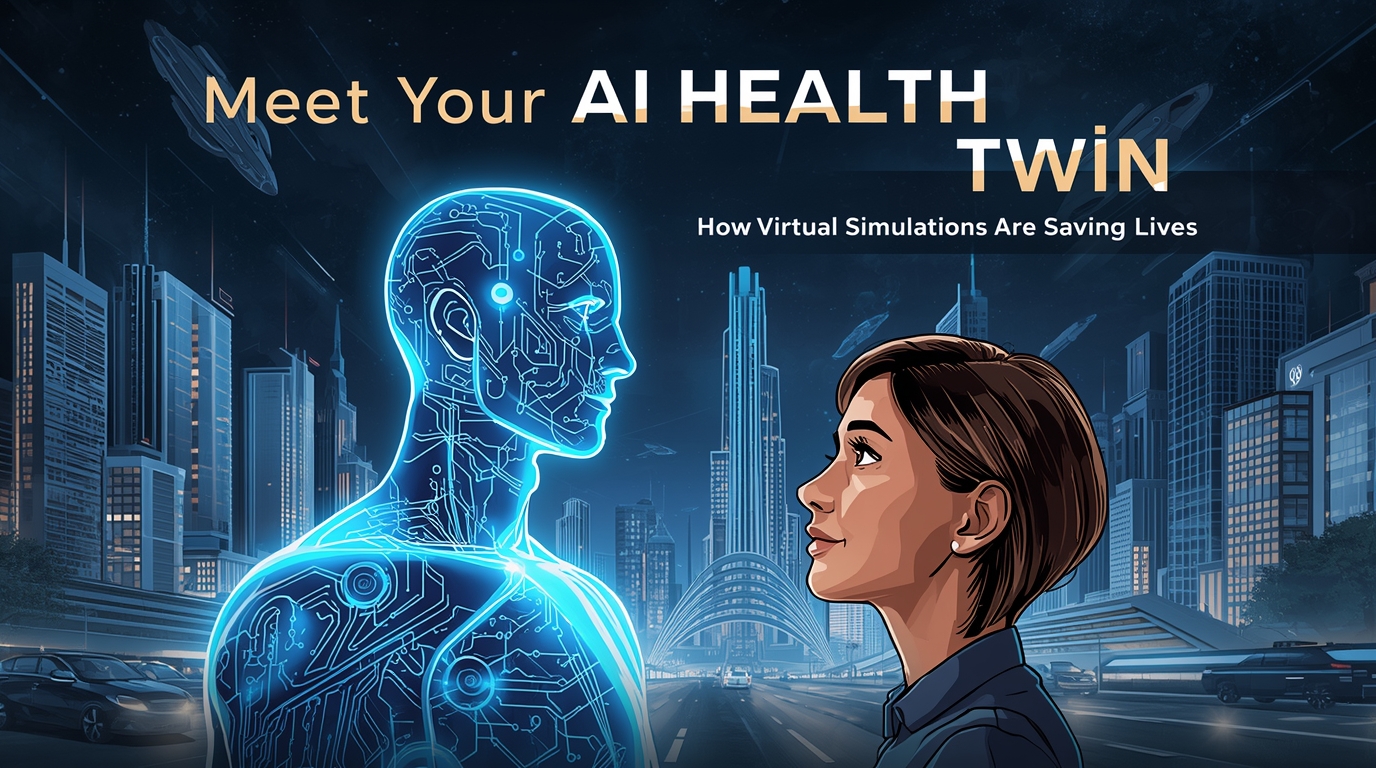
Let’s get one thing straight: Your AI Health Twin doesn’t look like a cartoon character with no legs. It’s a sophisticated, biological mirror built from your DNA, your blood test results, your wearable sensor data, and years of medical history.
Imagine a “Flight Simulator” for your body. Pilots use simulators to crash planes in a safe, digital world so they don’t do it in the real one. In 2027, doctors are doing the same with you.
-
The Blueprint: It starts with your Genome. This is the code that makes you you.
-
The Live Stream: It’s constantly updated by your “Smart Rings” and “Bio-patches” that monitor your glucose, cortisol, and oxygen in real-time.
-
The Prediction: AI algorithms look at this data and say, “Hey, based on how Physical Dave is eating and sleeping, Digital Dave is going to develop Type 2 Diabetes in 14 months. Let’s change something.”
The Comparison: Then vs. Now
| Feature | Old School Healthcare (2020) | AI Twin Healthcare (2027) |
| Diagnosis | Waiting for symptoms to appear. | Predicting the disease years in advance. |
| Medication | “Take two and call me in the morning.” | “We tested 50 doses on your Twin; this one is perfect.” |
| Surgery | The surgeon sees your heart for the first time in the OR. | The surgeon practiced on a 3D replica of your heart 10 times. |
| Data | Static PDF files from 2015. | A living, breathing data stream. |
1. The “Pre-Game” Surgery: No More Surprises
The scariest words in the English language used to be “We’ll have to see once we get in there.” In 2027, surgeons don’t “see once they get in there.” They’ve already been in there—virtually.
Before a complex procedure, doctors now load a patient’s specific anatomy into a simulation. If you have a weirdly shaped artery or a tumor hugging a nerve, the surgeon has already navigated those obstacles on your AI Twin.
The Funny Part: It’s basically like using a “Cheat Code” in a video game, except the prize is you staying alive. If the surgeon “fails” the level on the computer, they just hit restart and try a different angle. By the time they pick up the real scalpel, it’s basically a rerun.
2. Goodbye, Trial-and-Error Medications
We’ve all been there: The doctor gives you a pill, you take it, and three days later you have a rash, you can’t stop yawning, and you’ve forgotten your own middle name.
In 2027, your AI Twin takes the meds first.
-
The “In-Silico” Trial: Pharmaceutical companies use “Digital Populations” of AI twins to test drugs. This means fewer lab rats and faster “miracle” cures.
-
Personalized Dosing: Instead of a standard 50mg dose for everyone, the AI calculates that you specifically need $42.5mg$ because of your unique liver metabolism.
“In the past, we treated the ‘average’ human. But nobody is average. We are all weird biological snowflakes. The AI Twin finally respects the snowflake.” — Dr. Aris Thorne, Digital Health Specialist.
3. The End of “Late-Stage” Anything
The real magic of the Health Twin is its ability to Fast-Forward.
AI can take your current health data and run a simulation 10, 20, or 30 years into the future. It’s like a crystal ball, but with more math and fewer headwraps.
-
Early Warning: It spots the tiny “deceleration zones” in your heart’s electrical signal that lead to a stroke a decade later.
-
Lifestyle Gamification: If you’re wondering if that daily 4:00 PM donut is actually hurting you, you can ask the AI to show you your 2045 Twin with and without the donut.
-
Chronic Management: For people with conditions like Asthma or Diabetes, the Twin predicts “flares” before they happen, suggesting a dose of medicine before you start wheezing.
The Emerging Signals: Where is This Going?
While we’re already using Twins for hearts and lungs, the “signals” for the next two years are getting even more wild.
-
The Mental Health Twin: Researchers are working on simulating neurochemistry. Imagine an AI that can predict a depressive episode or a burnout phase based on your sleep, speech patterns, and cortisol levels.
-
The Longevity Twin: This is the “Billionaire’s Favorite.” People are using Twins to see which “anti-aging” supplements actually slow down their cellular clock and which ones are just expensive pee.
-
The “Community” Twin: Cities are creating digital twins of entire populations to see how a new park or a change in air quality affects the overall health of the neighborhood.
Wait, Is This Creepy? (The Ethics Check)
You’re probably thinking, “Great, so a computer has a map of my entire soul and body? What if it gets hacked?”
It’s a valid fear. In 2027, Data Sovereignty is the big debate.
-
Who owns Virtual You? If a company owns the simulation of your heart, can they charge you for the results?
-
Insurance Nightmares: Could an insurance company raise your rates because your Virtual Twin developed a disease that hasn’t even hit your Real body yet?
The industry is moving toward “Biometric Encryption,” where your data is locked behind your own unique biological key. But still, it’s a bit weird knowing there’s a version of you in a server farm somewhere that never sleeps and never eats pizza.
Conclusion: You, But Better
The AI Health Twin isn’t about becoming a robot. It’s about using the best technology we’ve ever built to protect the most fragile thing we own: our lives. By 2027, we’ve stopped guessing and started simulating.
We’ve moved from a world where we “hope for the best” to a world where we “test the best” on a digital version of ourselves first. It’s safer, it’s faster, and it means you might actually live long enough to see what other crazy stuff we invent by 2040.


